Bullet journal mood tracker spreads make an effective tool for monitoring emotions on good and bad days, promoting reflection and self-awareness, and providing an opportunity to make positive changes for increased happiness.
What is a Bullet Journal Mood Tracker?
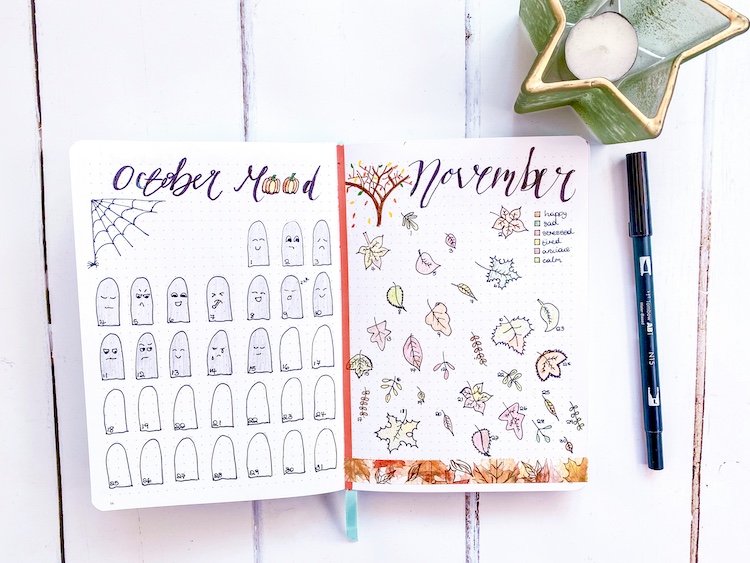
Mood tracker bullet journaling spreads are simply a great way of keeping track of your mood across a certain time period.
Usually this is done each month on a daily basis, giving you sufficient data to notice patterns which might correspond to other things going on in your life, such as sleep or hormones. (You can also create a similar spread using Level 10 Life, which can be used for assessing your mood and other areas of your life at the beginning and end of the year, and setting yourself goals to make improvements.)
There are many different and creative kinds of bullet journal emotion tracker available, depending on your personal requirements, such as time and level of detail, and I’m going to go over some of those in this post.
I’m also including a mood tracker printable pdf section, where you’ll also be able to print off a cute leaf design for your personal use.
Why Should I Track My Mood in My Bullet Journal?
You may be wondering what the purpose of keeping a monthly mood tracker is, and of course I’ve researched this so I can share the scientific benefits of doing so.
What is the point of a mood tracker?
Keeping track of your emotions is a great idea for many reasons. It’s a powerful way to monitor different moods and take charge of your life. How? Because it enables you to do the following:
1. Find Clarity
Essentially, a bullet journaling tracker brings clarity, at a glance.
It’s easy to ride the waves of life, having an idea of your usual frame of mind, but without really having any certainty over whether you have more good days or bad.
And if you feel that perhaps your mood is generally trending downwards, it can take some time to actually notice, and far longer to identify why.
Tracking your daily mood can take away that guess work by giving you a clear map of your emotions over a given period. This is especially true if you choose to use a more detailed design, which allows for a more comprehensive snapshot of your feelings each day.
Essentially, a bullet journaling tracker brings clarity, at a glance.

2. Notice Patterns in Your Moods
It might be that there’s no upward or downward trend per se, but a definitive wave of mood swings!
If this is the case and you start seeing a pattern of highs or lows – or indeed or if you notice an upward or downward trend – then having a mood journal of recent weeks will be invaluable to help you figure out what’s going on.
Critical self-analysis will bring a heightened awareness of the things that bring you happiness, versus those that compromise your peace of mind
You’ll be able to cross-reference your mood tracker spread with other trackers such as sleep, menstrual cycle, alcohol intake, etc, so that you can look for patterns in your daily moods.
This is especially useful if you suspect you may be struggling with any mood disorders such as anxiety or depression, and may be beneficial to take with to see your GP.
3. Increase Self-Awareness
This study suggests self-tracking mood could help maintain emotional wellbeing by facilitating awareness of mood patterns.
Examining these patterns in data you’ve collected over previous weeks will enable you to reflect on what’s working in your life, and what may be holding you back.
This critical self-analysis will bring a heightened awareness of the things that bring you happiness, versus those that compromise your peace of mind – and that you may ultimately need to change.

4. Identify Your Triggers
We all have times we either fly off the handle – or at least feel like we could.
The difference between the two is simple: understanding what triggers you, and then finding a strategy for avoiding those triggers where possible, or an effective coping mechanism for when that’s not an option.
But while the difference is simple, the reality is not easy – we are not always that aware of what’s going on to bring on those strong feelings in the first place.
A useful aspect of mood trackers is that by analysing the mood patterns you record at the end of the month, they can help you to identify your triggers, which is the starting point for developing those coping skills.

5. Remove Stressors and Triggers
It’s vital that you develop healthy mechanisms for coping with the stress or pain your triggers provoke.
Once you’ve recognised your stressors and triggers, this is your opportunity to figure out how you can remove them from your life, as much as possible.
Where triggers are concerned, this can be a very challenging step, both practically and emotionally – for example when a job or relationship is causing the problem – and in some cases it’s simply not feasible.
6. Develop and Implement Calming Measures
In situations where you’re not able to eliminate your stressors or triggers, it’s vital that you develop healthy mechanisms for coping with the stress or pain they provoke.
In fact, in an ideal world you would learn healthy coping mechanisms for the stressors, and you would disarm the power of the trigger, by healing the wounds at their root.
Committing to tracking your mood can lead to increased positivity, and amplify your feelings of wellbeing.
Stressors are life’s annoying little niggles. We all have them, and while we may be able to implement strategies to lessen their impact, being better organised for example, we cannot remove them entirely.
Using techniques such as deep breathing or meditation can be useful for dealing with these kinds of moments of stress.

Triggers, on the other hand, take us back to a traumatic event. Avoiding them altogether is a great strategy – but it’s not practical to completely rely on this method: we cannot control our environment absolutely.
Studies have shown that odour is our strongest sensory cue for recalling personally meaningful memories (here’s why). Which means that this strategy is likely futile – and that’s why healing our wounds is a better option.
Depending on your personal circumstances and preference, you could try healing inner child work which can be practiced alone, or working with a therapist or coach.
Bullet Journal Mood Trackers Can Help You Achieve a More Positive Outlook
Essentially, committing to tracking your mood can lead to increased positivity, and amplify your feelings of wellbeing.
Positivity is so much more than just cheerfulness and a sunnier deposition.

Benefits of a Positive Mood
The benefits of a positive mood? That sounds almost patronising, right? Because positivity equates to happiness, and who wouldn’t want more of that?
Here’s the really fascinating thing: positivity is so much more than just cheerfulness and a sunnier deposition.
Positive mood also influences our life choices and has awesome physical benefits; it can:
- Enhance cardiovascular, hormonal and immune functions;
- Promote healthy behaviors such as better sleep and exercise;
- Lead to more open-minded thinking and effective problem solving.
Which Mood Chart is Best For My Needs?
Easy – the one you’ll be motivated to keep up!
As with all kinds of bullet journaling, it’s important to be finding joy – or at least satisfaction – in your practice. If you maintain enthusiasm, you’ll likely maintain motivation too, and that’s key to the value of journaling.
With so many fun ways to keep track of your mood, there are some questions you can ask yourself to find the mood tracker that will best suit your needs. Consider the following:
- What inspires me?
- How often do I want to record my mood?
- How detailed do I want my chart to be?
Armed with the answers to these questions you can find (or create!) a beautiful mood tracker that fits your requirements and your purpose – and that you love the appearance of.
You can either record your overarching mood for the day, or perhaps what event may have triggered an emotion.
Of course, a bonus of this aspect of journaling is the creativity involved.

After all, we know that adult colouring – otherwise known as art therapy – is beneficial for our mental health, as this study and this study show.
What Information Should I Include on My Mood Tracker?
It’s entirely up to you, but you can either record your overarching mood for the day, or perhaps what event may have triggered an emotion.
Naturally, the more detail you include, the easier it will be to analyse later. With this in mind, it might be useful to record things such as your menstrual cycle or if you’ve had a bad night’s sleep.
Of course, there’s nothing to stop you keeping more than one tracker at a time – one for mood, another for your menstrual cycle, another for your alcohol intake or activity levels for example.
Just be careful not to overwhelm yourself with too much, as this may lead to fatigue or burnout, and you’ll be less motivated to fill out your bujo habit trackers.
How Should I Record My Mood on My Bullet Journaling Mood Tracker?
This really depends on the level of detail you want to include, but popular ideas include:
- Colours
- Symbols
- Words
If you’re keeping things simple, you can just use colour with a color key.
If you want to get more specific, then you may want to consider using different colors or different shades alongside words or symbols to represent moods.
If you’re committed to tracking for the entire year, don’t be afraid to try alternatives for each month of the year until you find a design or style that suits you.
Bullet Journal Mood Tracker Ideas and Inspiration!
Now you know how to create and fill out a mood tracker, here’s some inspiration for creative ways to get started.
Here are some of my favourite cute mood trackers:
Cloud Bujo Mood Tracker
Umbrella Bullet Journaling Mood Trackers
Sunflower Emotion Tracker
Ice Cream Themed Mood Tracker
Coffee Mood Tracker
Halloween Mood Tracker

Leaf Bullet Journal Emotion Tracker

Balloon Bullet Journaling Mood Tracker
Festive Mood Tracker

Galaxy Bullet Journal Mood Trackers
Bunting Mood Tracker
Polaroid Mood Tracker
Rainbow Mood Tracker Ideas
Honeycomb Bullet Journal Mood Tracker
Bubble Bujo Mood Tracker
Ocean Themed Emotion Tracker
Blossom Tracker
Hopefully these gorgeous designs will have inspired you to have a go at recreating your own mood tracker!
Mood Tracker Printable PDF
If you’d prefer something to get you started, head over to the resources page and sign up for exclusive access to all of our printables for free! You’ll find a leaf design mood tracker, similar to the hand-drawn one in the post, as well as our selection of habit trackers.


Choose an elaborate or simple design, with bight colours to reflect your bright intentions to take control of your mental health!
Either way, mood tracking is a fun way to monitor your good and bad days, to help you get a handle on your emotions, enabling you to see, at a glance, where you may be able to find a better way to live for an improved overall mood.