Rotating toys is a great way to reduce toy clutter which increases play space figuratively and literally, making your home a calmer and more pleasant place to be for the whole family. Learn how toy rotation works, and why it’s worth exploring the idea.
How Rotating Toys Can Lead to a Calmer Home
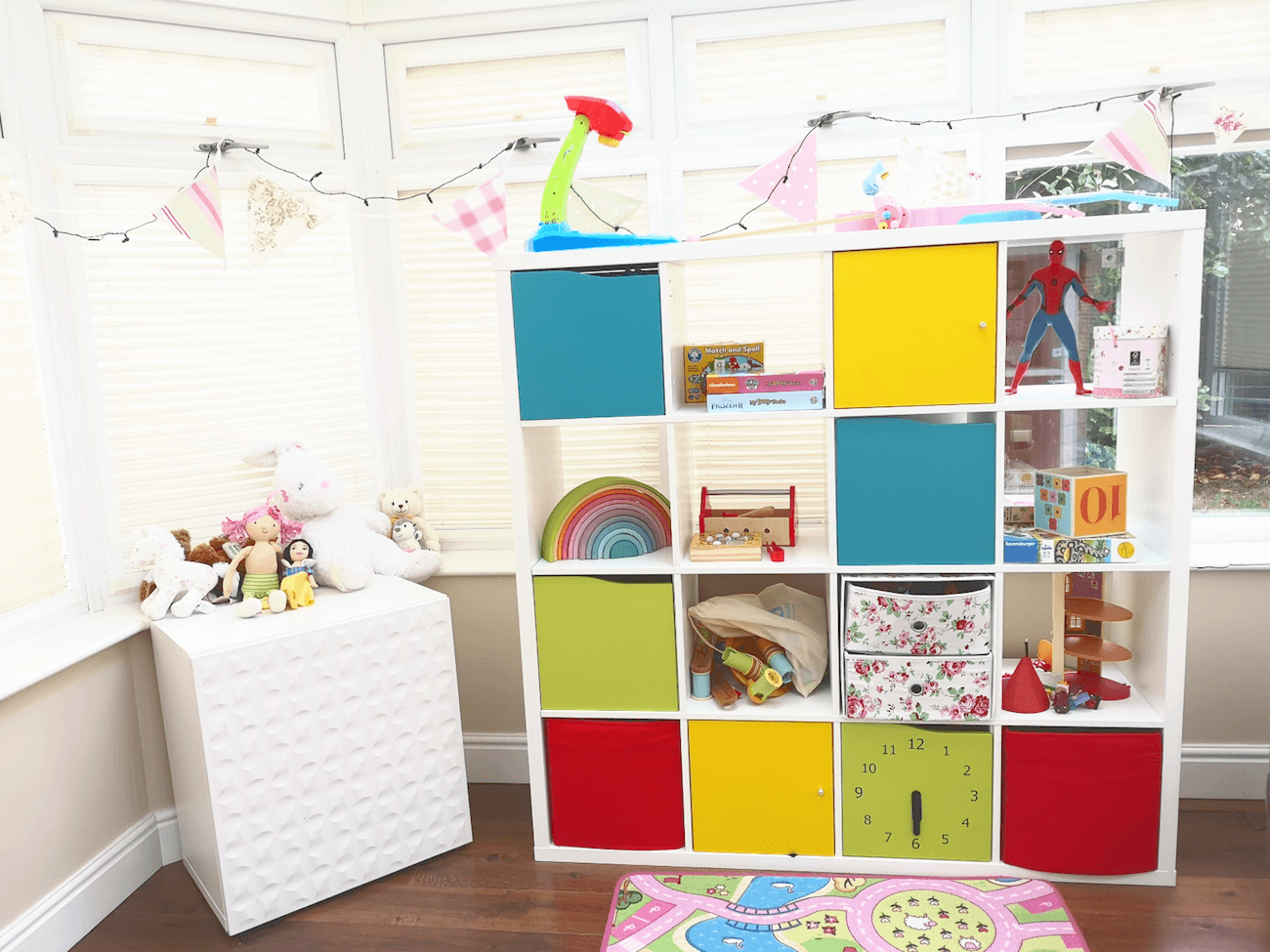
I finally did it! One evening recently, despite being tired from mumming during a pandemic, I got the kids to bed and I fiiiinally put into practice the thing I’d been promising to do for literally years: rotating toys.
I ruthlessly took the playroom to task, and joyfully discovered how toy rotation benefits the whole family – and it’s been a revelation.
What Does Toy Rotation Mean?
Toy rotation is, simply, rotating sets of toys.
The idea behind toy rotation is to keep all items fresh, and therefore in use. Too many toys can very quickly become overwhelming for children, resulting in several issues dependent on age – all of which we were experiencing unnecessarily.
They’re affected by toy overwhelm.
3 Problems Which Can Be Solved With the Art of Toy Rotation
Like most family homes, over the last few years we’ve accumulated a lot of toys.
Every Christmas and birthday is a fresh source of stress because I know it’s time to organise space for more stuff we don’t need. I try to limit how many new toys are bought for our girls, but obviously that’s difficult to enforce! I know, 21st century problems.
Our girls are nearly three years apart in age. Now, while they can be very good at playing together, they also have their own age specific needs. In different ways, they’re also each affected by toy overwhelm thanks to their huge variety of toys.
Both enormously frustrating issues for parents.
But especially this parent who can’t bear mess, and especially in the middle of a pandemic when there’s an inevitable loss of structure, routine, and pursuits away from home.

Thankfully, employing this toy hack is a game changer. Here are three reasons I’m glad I finally got around to organising our playroom so that I can easily rotate toys at regular intervals.
It has helped to fix:
1. Lack of Direction
Elfin recently turned three. She’s bright, but she can’t reach the toys that are high up, and she can’t regulate her behaviour too well.
I was finding that most days she’d simply pull out everything within her reach and sit in the middle of a pile of toys that had no cohesive purpose, and which she didn’t know what to do with.
She’d quickly tire of the mess since there was no direction for her play, and subsequently lose interest; her attention span was extremely low unless her sister (or I) was helping to direct play…
2. Toys Being Ignored
Pixie is nearly six. Imaginative play is second nature for her, which is great.
However I was noticing that she rarely used anything other than her firm favourites. Which isn’t a problem, but I did wonder if she was perhaps missing out on some valuable learning from other types of play. She’s also very keen to have more time to play independently, without her sister ‘gatecrashing’ her games.
3. Mess
Lack of direction seemed to be really be a big problem.
Mummy is feeling old. Mummy is fed up with needing to constantly entertain Elfin and referee between the girls. Mummy is definitely fed up with the bomb site at the end of every day, and the huge waste she sees in too many toys, none of which are being properly / fully engaged with in an effective and valuable way…
Both of the girls are inclined to get hold of all of the little bits that go with various toys, mix them up, and dump them around the house, with no clear objective. Lack of direction seemed to be really be a big problem – for them and me.
Mummy needed to fix the problem.
Having fewer toys creates focus and direction.
Benefits of Toy Rotation
With the above in mind, there are some fairly clearcut benefits to toy rotation:
a) Rotating Toys Increases Focus
Having fewer options of available toys creates focus and direction, removing overwhelm; this in turn leads to more absorbing and creative play.

b) Toy Rotation = Fresh Toys = Interest
Because toys are regularly switched up, nothing loses its shine – or if it does it quickly becomes apparent, and it’s easy for you to simply remove it to be donated.
Similarly, you’ll likely notice that your child develops new favorite toys as they start ‘seeing’ everything on offer.
c) Rotate Toys to Aid Organisation
With less clutter, a set amount of toys can be carefully arranged as provocations, fascinations, and invitations to play – all of which should maximise curiosity, encourage independent play, and promote new experiences.
One important aspect here is easy access – be sure to keep appropriate toys at a level younger children can reach unaided. Similarly, it can work well to put toys for older children up high out of reach of younger siblings.

d) Montessori Toy Rotation Organically Maximises Space
With less mess, play area is increased, and you may be surprised that once properly set up, your children won’t (necessarily!) aim to fill that space with more clutter.
But they will enjoy another benefit…
e) A Toy Rotation System Ultimately Promotes Calm
Curiosity is sparked!
Tidy home, tidy mind – this is so true for me, and I’m fairly confident it applies to my children too, especially our eldest.
Pixie thrives in a calm and quiet environment. And while Elfin seems relatively unbothered by chaos, she plays far better with our new set up of fewer toys – her attention is held, her curiosity is sparked, and her imagination runs wild.
I’ve also noticed fewer items strewn around our living room since implementing this system. Plus there’s the added benefit of less mess for me to clean up come bedtime, which is a nice bonus too.
f) Coffee

Okay, this one is all about me.
But at a time when there are sleep regressions for one (broken arm and associated trauma), and normal sleep for the other (which I’d wager is the equivalent to a sleep regression in most homes), I’m feeling constantly drained.
Oh, and there’s a pandemic too of course, which brings its own challenges, and compounds the need for caffeine. So the fact that better entertained children plus a more peaceful home equates to more hot coffee, is also a huge benefit!
And those few minutes for me each day are basically all the self-care I’m getting right now. So they are precious.

I think I just made the leap that toy rotation has allowed me to practice self-care, which seems a bit far-fetched – but it has honestly been a game changer.
Tips For Successful Toy Rotation
Here are a few tips to help you approach what may well feel like an enormous task, but will be so worth the effort and will probably take less time than you anticipate too.
- This is not a job to be done in front of the children, unless they’re significantly older and are taking an active part in the process.
- You may find it becomes necessary to purchase storage bins and/or dedicated units (such as a cube shelf unit) for your playroom or child’s bedroom.
- Bear in mind that some items will be impractical to rotate, generally bigger toys which are simply too large to put away, ie. play kitchen.
- Choose a place to store toys which is out of your child’s view and reach, but is fairly easily accessible.
- If you have more than two boxes to rotate, number them!
- You may also like to note what is in each of your rotation boxes for reference.

How Do You Set Up a Montessori Toy Rotation System?
We’ve established the benefit of rotating toys, but how do you do it effectively? Well, there are a couple of principles to follow, but it’s a fairly simple system to implement:
1. Plan
Find a time to get organised when the kids are not around.
Within your plan, consider:
- How many of your child’s toys you want out at a given time,
- Where and how they’ll be displayed,
- Where and how you’ll store the toys that are out of rotation,
- How many ‘sets’ of toys you want in rotation (just two with one in, one out; or will you have multiple sets in storage to be rotated in?)
- How many areas of your home will be set up with an organised selection of toys, ie. playroom / living room / kids’ bedrooms.
These things may be dependent on your children’s ages, the number of toys you own, the space you have available both for storage and display, and ease of access to the toys in storage.
Once you’re ready to proceed, find a time to get organised when the kids are not around.

2. Cull
Remove anything broken, set aside anything with missing pieces that make the toy useless, make a pile of old toys which have been outgrown, and replace batteries where required. You can then sort toys into piles for the bin, charity shop, and those to be kept in rotation.
Part of this stage will also include acknowledging which items are going to stay in rotation at all times, such as large toy kitchens.
3. Group
Items should be be grouped into toy categories, with around two or three items from each type of toy kept in every ‘set’ to be rotated. This number should provide choice, while keeping the volume manageable for you and your child/ren.
Types of toys could be loosely grouped around different toys for:
- Cognitive Development
Think shape sorters, puzzle pieces and jigsaws, board games and such.
- Gross Motor Skills
Active movement toys including things like ride on trikes, wobble boards, kids stilts, mini trampolines, etc.
- Fine Motor Development
Construction toys such as nesting boxes, stacking blocks, Legos, and Grimms’ rainbows for example.

- Musical instruments
Tambourines, drums, mini pianos, whistles and the like.
- Social and Emotional Development
Open-ended toys for pretend play including tea sets, Grapat Nins, garage sets, shop tills, dressing up clothes and anything else likely to encourage the development of language and social skills.
- Creative
Art supplies (pens, pencils, crayons, colouring books, play dough, kinetic sand, etc) may be included within your groups. Or depending on your situation and space you may prefer to keep it all aside and bring it out under supervision (my preferred method!).
That’s the beauty of the system!
- Books
Depending on how many books you own and the way in which they’re stored, you may choose to include these or not.
We have so many books that it’s simply not practical for us to rotate them in and out, though I wish we could to encourage a wider range of reading. This is something I may look at later, but for now it’s just too much.
How Often Do You Rotate Toys?
Observation is key: closely monitor which toys are being played with and, when you notice some being ignored for days in a row or a general declining interest, then it’s a good time to switch things up. With older kids you can simply ask them!
You can choose to pull out individual toys if there’s something specific being played with a lot and others being largely ignored, but in my opinion this is making extra work for yourself and I prefer to do a straight swap, set for set.
I recommend keeping any current favourites in the first rotation, and you need only rotate when they begin to lose favour – that’s the beauty of the system!
That said, you may choose to schedule a weekly toy rotation, just so you keep on top of it.